Wednesday, July 1, 2020

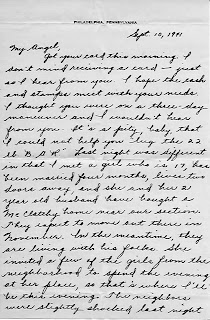
Post #71 - September 24, 25, 1942 Back to Ft. Meade and So Here Goes Our First Letter


The reason why my father found himself back in the Army (with a 9-months pregnant wife) in September, 1942, after being discharged from the Army in September of 1941:
From Wikipedia—
After Pearl Harbor the STSA [Selective Training and Service Act] was further amended (December 19, 1941), extending the term of service to the duration of the war plus six months and requiring the registration of all men 18 to 64 years of age. During World War II, 49 million men were registered, 36 million classified, and 10 million inducted. 18 and 19 year olds were made liable for induction on November 13, 1942. By late 1942, the Selective Service System moved away from a national lottery to administrative selection by its more than 6,000 local boards.
On December 5, 1942, presidential Executive Order 9279 made it so that all men from the ages of 18 to 37 could not voluntarily enlist for the duration of the war, providing protection for the nation's home front manpower pool. The Navy and Marine Corps began procuring their personnel through the Selective Service System in early 1943. The Navy and Marine Corps enlisted inductees and volunteers under the same service agreements, but with different service obligations, while the Army placed wartime inductees and volunteers into a special service component known as the Army of the United States, commonly known as the "AUS"; service commitments were set at the length of the war plus six months.



Monday, June 29, 2020

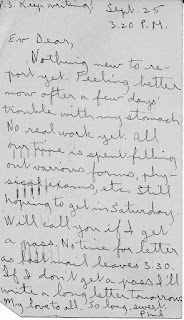
Post #69 - September 15, 1941 Second Honeymoon


This is the last letter I have from 1941, as my father was discharged from the army. The new modest home into which they so lovingly dreamed of moving, and which they often wrote of decorating, never materialized. They did not pass for the mortgage. As a result, during the war years, my mother moved back to a neighborhood in Philadelphia called Logan to live with her own mother, father, three brothers, and sister. Eventually, the whole extended family including me and my brother and sister, all lived in the same row home until such time as each one of us married. My father’s mother, who was widowed at a very early age, moved to a neighborhood called Oxford Circle to live with my father’s younger brother, Harry, and his wife, Goldie. Philip returned to the armed services in September of 1942 as the war ramped up. More letters will follow. 


These are the last items I have dated 1941. The telegram is from my father’s youngest brother, Jack. The Christmas card is from my mother’s best friend, Anne. They stayed in touch all their lives, and Anne came to visit my mother when my mother was in her eighties.


Wednesday, June 24, 2020

Post #65 - September 8, 1941 Dreaming of Your Discharge and The 22-lb. B.A.R.*


*From Wikipedia:
The Browning Automatic Rifle (BAR) is a family of American automatic rifles and machine guns used by the United States and numerous other countries during the 20th century. The primary variant of the BAR series was the M1918, chambered for the .30-06 Springfield rifle cartridge and designed by John Browning in 1917 for the American Expeditionary Forces in Europe as a replacement for the French-made Chauchat and M1909 Benét–Mercié machine guns that US forces had previously been issued.
The BAR was designed to be carried by infantrymen during an assault[1] advance while supported by the sling over the shoulder, or to be fired from the hip. This is a concept called "walking fire"—thought to be necessary for the individual soldier during trench warfare.[2] The BAR never entirely lived up to the original hopes of the war department as either a rifle or a machine gun.[3]